Connect with us

Editorial

The Screwtape Letters in New Brunswick | Nov. 7–8

Shannon

Published

on

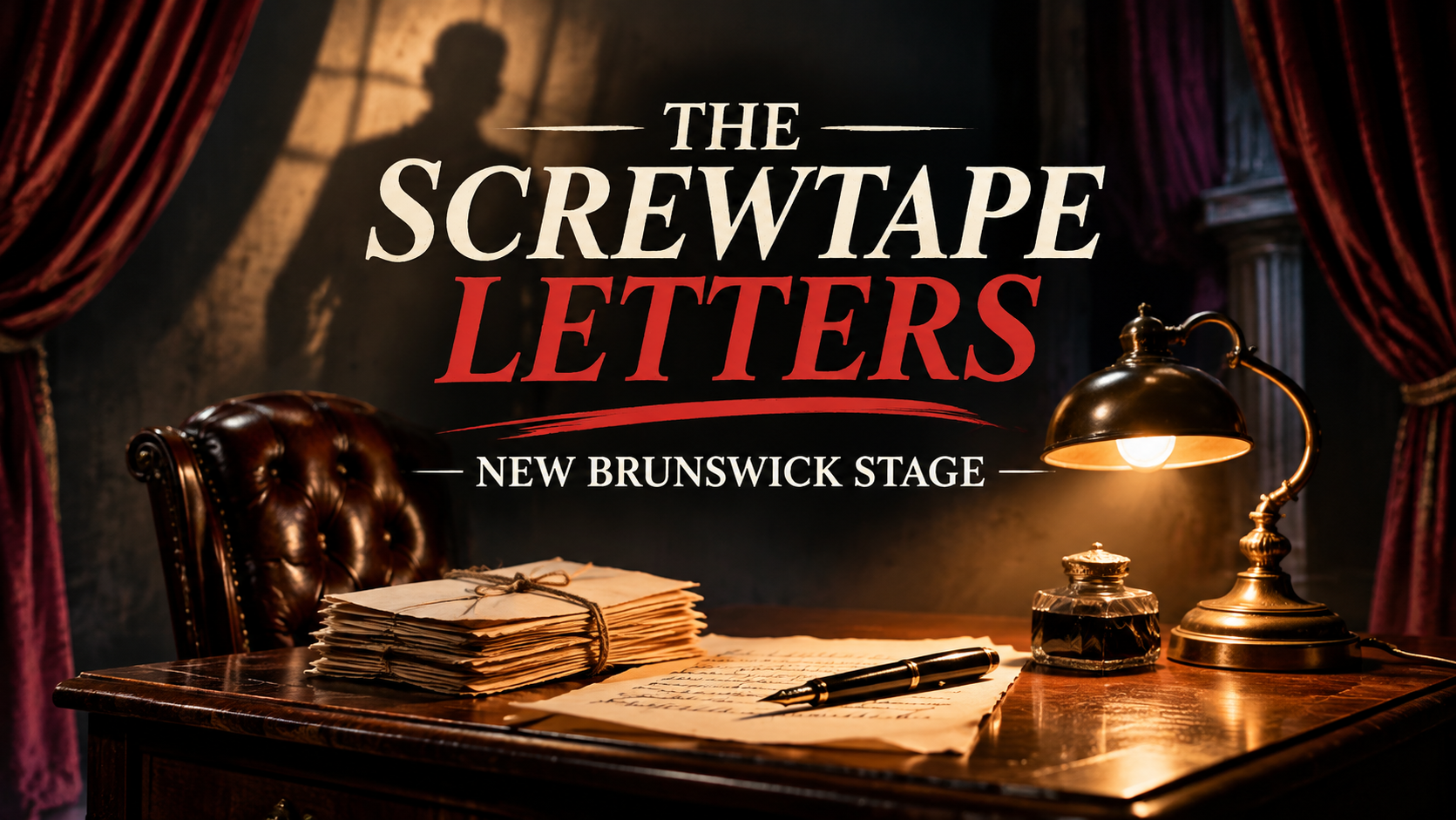
Promotional artwork for C.S. Lewis’ The Screwtape Letters stage production at New Brunswick Performing Arts Center.

More than 80 years after C.S. Lewis imagined a senior demon giving advice to his younger apprentice, The Screwtape Letters is still finding new audiences.

This weekend, the battle moves to New Brunswick.

Fellowship for Performing Arts is presenting its stage adaptation of Lewis’ Christian satire at the New Brunswick Performing Arts Center, with two performances today, Saturday, November 7, at 4 p.m. and 7:30 p.m., followed by a final performance Sunday at 3 p.m.

The production runs 90 minutes without an intermission and is recommended for audiences 13 and older. Children under 4 are not admitted. A short discussion follows the performance.

Hell Has an Office

The premise remains one of the most unusual in Christian literature.

Rather than telling its story from the perspective of a believer resisting temptation, The Screwtape Letters turns the camera around.

Screwtape is a senior demon in Hell advising his inexperienced nephew, Wormwood, on how to corrupt an ordinary human being referred to simply as “the patient.”

God becomes “the Enemy.”

Virtue becomes a problem.

Everyday weaknesses become opportunities.

The humor comes from watching familiar human behavior described from the opposite moral perspective.

Lewis first published the letters in installments during 1941 before the complete book appeared in February 1942. The work became one of his earliest major commercial successes, years before The Chronicles of Narnia made him a household name.

Taking an Epistolary Book to the Stage

Turning that structure into theater presents an obvious challenge.

The original work consists largely of letters from one demon to another, not conventional scenes filled with dialogue and action.

Fellowship for Performing Arts founder and artistic director Max McLean adapted and directed the stage production, transforming Screwtape’s correspondence into a theatrical performance centered on the demon’s office in Hell.

FPA describes the production as a faithful adaptation exploring temptation, spiritual warfare and human behavior through Lewis’ wit and satire.

The production has developed a long life of its own.

Fellowship for Performing Arts says The Screwtape Letters has previously had an extended New York run, a sold-out engagement in London and five U.S. tours. The organization has also acquired film rights to the work and announced plans to develop a motion-picture version.

Faith Without a Conventional Sermon

Lewis rarely approached Christianity by simply telling readers what to think.

In The Screwtape Letters, he used satire.

That gives the work an unusual place in religious literature and makes it particularly suited to a theater company trying to reach beyond a strictly church audience.

Fellowship for Performing Arts describes its mission as creating theatre and film from a Christian worldview for a diverse audience. The New York-based company has produced several works connected to Lewis and Christian thought.

The New Brunswick engagement is straightforward about its religious foundation, but the material itself spends much of its time examining recognizable habits: pride, distraction, selfishness, relationships and the small compromises people make without thinking much about them.

That may help explain why a book written during World War II can still fill theaters in 2026.

The technology changes.

Human nature is a little harder to update.

What to Know

C.S. Lewis’ The Screwtape Letters
New Brunswick Performing Arts Center
11 Livingston Avenue
New Brunswick, New Jersey

Saturday, November 7: 4 p.m. and 7:30 p.m.
Sunday, November 8: 3 p.m.

The production runs approximately 90 minutes with no intermission. Ticket availability varies by performance and seating section.

For readers who know Lewis primarily through The Lion, the Witch and the Wardrobe, The Screwtape Letters shows a very different side of the same writer.

No wardrobe.

No talking lion.

Just a demon at his desk trying to explain why human beings make his job so easy.

Editorial

Westfield Goes Full Addams: How One New Jersey Town Turned Halloween Into a Hometown Tradition

Cru Jones

Published

on

Every October, Westfield gets a little stranger.

Storefronts become creepy, front yards compete for bragging rights, visitors wander through an old cemetery by lantern light, and one of New Jersey’s most familiar fictional families seems to turn up everywhere.

There is a reason for it.

Westfield was home to Charles Addams, the cartoonist whose darkly funny drawings eventually became The Addams Family. In 2026, the Union County town celebrated that connection with the ninth annual AddamsFest, a monthlong series of events built around Addams, Halloween and the particular kind of humor that made his work famous.

What started in 2018 has become one of New Jersey’s more unusual fall traditions.

Before Wednesday, There Was Westfield

Charles Addams was born in 1912 and grew up in Westfield before going on to become a celebrated cartoonist whose work appeared regularly in The New Yorker.

The characters that would become the Addams Family first existed as individual cartoons rather than as the television family most people recognize today.

Decades later, Gomez, Morticia, Wednesday, Pugsley and the rest of the clan have survived television series, movies, animation, Broadway and, most recently, Netflix’s Wednesday.

Westfield has increasingly embraced its connection to the man who created them.

That connection now extends beyond putting his name on a plaque.

For a month, the town essentially turns itself into an Addams Family destination.

Walking Through Addams’ Westfield

One of the most interesting parts of AddamsFest is the Charles Addams Heritage Trail.

Guided tours on October 10, 17 and 24 retraced Addams’ childhood route through Westfield, including his home, school, downtown and the historic cemetery where he spent time as a boy. A self-guided version of the trail is also available for visitors who want to explore on their own.

The cemetery itself became part of the festival through lantern burial-ground tours.

That may sound like something created for Halloween tourism, but it fits Addams unusually well. His fascination with graveyards, old houses and the slightly unsettling side of ordinary suburban life began long before anyone knew the name Wednesday Addams.

The Associated Press highlighted Westfield’s transformation this fall, noting how the town has turned Addams’ childhood environment into a destination for fans of his work.

The Entire Town Gets Involved

AddamsFest is not confined to one park or one weekend.

Throughout October, downtown businesses participated in Wicked Windows of Westfield, with storefronts painted and decorated in Halloween and Addams-inspired scenes. Residents entered the annual Haunt Your House competition, with community voting determining favorite daytime and nighttime displays.

Mindowaskin Pond even received a floating Addams Family house installation.

The festival’s 2026 art exhibition, AddamsFest Americana, connected the celebration to America’s 250th anniversary. Original works by Charles Addams, loaned by the Tee & Charles Addams Foundation, were displayed alongside work by local artists examining American places, traditions and everyday life through an Addams-inspired lens.

There was also an Addams Family Fun Day on October 18, an outdoor screening of The Addams Family on October 23 and a downtown Wednesday Night Crawlers bar crawl on October 28.

For adults looking for something more elaborate, Morticia and Gomez’s Masquerade Ball returned October 10 at the James Ward Mansion with food, drinks, entertainment and costumes encouraged.

A Hometown Finally Owning Its Weirdness

There is something particularly New Jersey about the whole thing.

Plenty of towns can manufacture a Halloween festival.

Westfield does not need to invent the backstory.

One of the most recognizable families in American pop culture can trace its origins back to a cartoonist who grew up walking these streets, visiting these buildings and finding humor in the strange side of ordinary suburban life.

That gives AddamsFest something most themed festivals cannot buy.

A real connection.

And with Wednesday introducing another generation to Charles Addams’ characters, Westfield’s hometown story suddenly feels current again.

For most of the year, it is a polished suburban New Jersey town.

For October, it belongs to the Addams Family.

Continue Reading

Editorial

Is the Jersey Shore Becoming Too Expensive for the Families Who Built It?

Shannon

Published

on

By

For generations, a trip “down the Shore” has been more than a vacation.

It’s a tradition.

The same beach house every summer. The same pizza on the boardwalk. The same miniature golf course where the kids insist on keeping score, even though no one remembers who won last year.

For many families in New Jersey, New York, and Pennsylvania, these rituals have become part of the family story.

But this week, a viral social media video reignited a question many have quietly been asking for years:

Has the Jersey Shore become too expensive for the very families that helped make it what it is?

The discussion began after a Philadelphia mother shared that her family spends roughly $10,000 each year to rent a Shore house. That figure, she explained, doesn’t include groceries, beach badges, gas, restaurant meals, or many of the other expenses that come with a week at the beach. Her comments drew thousands of reactions from people who questioned whether the cost could possibly be justified.

Some commenters suggested that for the same money, families could travel to Europe or spend a week at a Caribbean resort.

Others immediately pushed back.

Because to many Shore families, they argued, that’s missing the point.

You don’t come to the Jersey Shore because it’s the cheapest vacation.

You come because it’s your vacation.

You return to the same streets where your parents pushed your stroller. You stop at the same ice cream stand. You wave to neighbors you’ve only seen one week each summer for the last twenty years. Your children grow up with friends they may only see during that single week in July.

That kind of tradition is difficult to put a price on.

Still, the financial reality is impossible to ignore.

Research released earlier this summer found that the overall cost of a Jersey Shore vacation has risen by more than 11 percent compared with last year, while weekly rental prices in several popular Shore towns increased dramatically. Rising property values, insurance costs, taxes, fuel prices, and everyday expenses have all contributed to the increase.

For many working families, that means difficult decisions.

Do you shorten the trip?

Stay farther from the beach?

Skip dinners out?

Or simply decide that this is the year you don’t come at all?

These aren’t just economic questions.

They’re cultural ones.

The Jersey Shore has never belonged exclusively to one income group. Its identity has been built by firefighters, teachers, nurses, police officers, tradesmen, small business owners, retirees, and families who planned all year for one special week together.

That accessibility has always been part of its charm.

At the same time, Shore communities face their own financial pressures. Property owners contend with rising insurance premiums, maintenance costs, labor shortages, and increasing property taxes. Many rental rates reflect those realities rather than simple profit. It’s a balancing act between keeping family traditions alive and covering the real costs of owning property along one of the most desirable stretches of coastline in the country.

Perhaps the better question isn’t whether the Jersey Shore has become “too expensive.”

It’s whether we can preserve the traditions that made it special while ensuring future generations still have the opportunity to experience them.

Because the Shore has never been just about the beach.

It’s about grandparents teaching grandchildren how to catch a wave.

It’s about late-night walks on the boardwalk.

It’s about watching the sunrise with a cup of coffee before everyone else wakes up.

Those memories have always been the true value of a Jersey Shore vacation.

And if those traditions begin slipping out of reach for ordinary families, New Jersey risks losing something far more valuable than a week’s rental income.

It risks losing a piece of its identity.

Continue Reading

Editorial

The Greatest Generation Built America. Who Will Build the Next 250 Years?

Editor-in-Chief

Published

on

The Jersey Review 250th USA

Next year, America will celebrate its 250th birthday.

For a nation that has weathered wars, economic depressions, scientific breakthroughs, and generations of change, the milestone offers more than fireworks and parades. It presents an opportunity to pause and ask an important question:

What kind of country are we leaving to the next generation?

Much has been written about the “Greatest Generation,” those Americans who endured the Great Depression, fought in World War II, returned home, built businesses, raised families, and helped create decades of prosperity. Their legacy can still be seen in our highways, neighborhoods, schools, churches, and small businesses.

But every generation faces challenges unique to its own time.

Today’s Americans are navigating rising housing costs, changing technology, an evolving job market, and economic uncertainty. Many families have relied on some form of temporary assistance at different points in their lives, whether through unemployment benefits, disaster relief, food assistance, veterans’ programs, scholarships, or help from local charities. There should be no shame in accepting help when life takes an unexpected turn. Communities are often strongest when neighbors lift one another up during difficult seasons.

The larger question is what comes next.

How do we create a society that not only helps people through hardship but also encourages opportunity, independence, and long-term success? That conversation deserves thoughtful discussion, not political slogans. Families remain the first place where values are taught. Parents and grandparents often pass down lessons about responsibility, perseverance, generosity, and service long before children enter a classroom. Churches, synagogues, mosques, and other faith communities continue serving millions through food pantries, mentoring programs, counseling, addiction recovery, and volunteer outreach. These institutions frequently meet needs that government programs alone cannot address. Teachers, coaches, employers, and local business owners also play important roles. A first job, a trusted mentor, or someone willing to take a chance on a young worker can change the course of a life. Small businesses, in particular, have long been engines of opportunity in communities across New Jersey. They don’t simply create jobs. They teach skills, build confidence, and provide stepping stones for future entrepreneurs.

Self-reliance and compassion do not have to compete with one another. A healthy society can value both. Helping a struggling neighbor while encouraging personal growth is not a contradiction. It is often how strong communities have always operated. As America approaches its semiquincentennial, perhaps the greatest tribute we can pay to previous generations is not simply remembering what they built. It is continuing the work. That work may look different today than it did in 1946 or 1976. It may involve new technologies, different careers, and changing economic realities. But the principles that have strengthened communities for generations remain remarkably familiar: hard work, personal responsibility, strong families, engaged neighborhoods, and people willing to invest in one another.

The next 250 years of American history will not be written by governments alone.

They will be written by parents raising children with character, teachers inspiring curiosity, employers opening doors, volunteers serving quietly, entrepreneurs taking risks, and neighbors helping neighbors when life becomes difficult.

History remembers the generations that build.

The question now is whether ours will be remembered as one of them.

Continue Reading

Trending